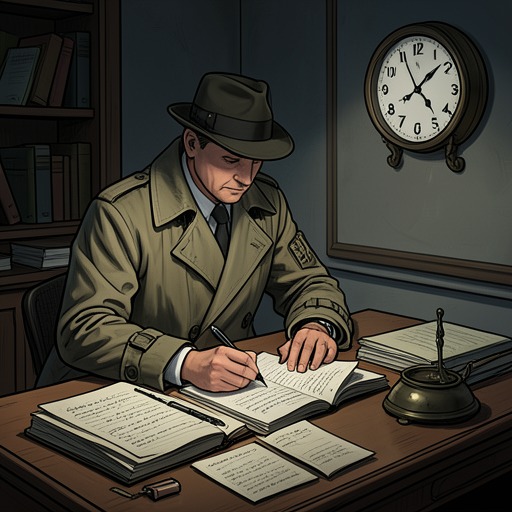
Larry Crompton
I'll Be Gone in the DarkLarry Crompton was an investigator who came to treat the East Area Rapist cases as an unfinished responsibility. He first encountered the investigation at a Sacramento County crime scene, then joined the urgently assembled task force and continued following the case after the offender’s attacks moved beyond the area. The narrative presents Crompton as both a close reader of investigative details and a witness to the costs of a fragmented law-enforcement response.
Identity and Entry into the Case
Crompton’s defining connection to the case began before he knew how long it would occupy him. At 5:19 a.m., deputies dispatched to a crime scene arrived to find clues that included knotted white shoelaces, strips torn from an orange towel, and severed telephone lines. The house’s thermostat and radio had been turned off. Crompton, then working as a crime-scene investigator, arrived as the scene began to fill with people and the investigation shifted toward identifying useful details.
The surroundings helped shape his initial assessment. A Realtor’s sign stood in the front yard, the adjoining property was vacant, and railroad tracks ran behind the house. Crompton read these circumstances as conditions that suited the offender’s compulsions and narrowed his attention to a particular target. The scene offered more than evidence inside a house: its relation to nearby spaces formed part of the problem investigators had to understand.
Within weeks, Crompton was promoted to sergeant and joined the East Area Rapist Task Force. The case would become the one he carried for the rest of his life. The narrative’s image for that endurance is a game of incomplete guesses: each mistaken answer brings the investigation closer to defeat, but Crompton keeps the final move open for himself or a successor. The goal is not abstract vindication; it is the still-missing name that would complete the pursuit.
Reading Patterns Amid Fragmented Information
Crompton understood the East Area Rapist’s movement between locations as a warning rather than a reason for relief. When the offender disappeared from the East Bay in the summer of 1979, Crompton’s superiors were relieved. Crompton was alarmed. In his assessment, the offender was escalating: he appeared to require more fear from victims, and his threats had become more severe and less constrained. Crompton worried that the offender was shedding inhibitions at a moment when he needed to be contained, not emboldened.
That concern developed in a law-enforcement environment where information moved poorly between agencies. In the late 1970s, jurisdictional cooperation was described as deeply inadequate; police Teletype and informal word of mouth were among the few ways officers learned about cases elsewhere. The East Area Rapist’s disappearance from one region could therefore obscure rather than resolve the threat. Crompton’s attention to the change in the offender’s behavior gave him reason to take reports from other parts of California seriously.
The broader investigation also depended on understanding how the offender selected and prepared around neighborhoods. Reports described a preference for single-story houses, often near open space and situated second from a corner. Before some attacks, there were signs of prowling and unlawful entries nearby, missing small items, and an increase in hang-up calls within a limited radius. These details suggested reconnaissance: the offender was studying residents and their routines, and preparing alternatives before a particular night. Crompton’s concern about escalation belonged to an investigation in which patterns of place and timing could carry meaning even when agencies did not share information reliably.
Casework, Colleagues, and the Santa Barbara Lead
Crompton’s work on the task force created a close professional connection with Jim Bevins, an investigator with the Sacramento Sheriff’s Office. In early 1980, Bevins called him with reports from Santa Barbara: a couple of cases, including a homicide, seemed to resemble the East Area Rapist’s crimes. Bevins was trying to step away from the case, whose hold on him had damaged his marriage, but he wanted Crompton to know what he had heard. Their working relationship thus carried information forward even as one investigator tried to withdraw from the investigation.
Crompton acted on the lead. He called south, urging a colleague to begin with Santa Barbara and reporting that he had heard of several bodies there. The call reflects the practical importance of informal connections in a period when interagency systems were weak: a rumor passed between investigators could prompt a new line of inquiry. It also shows that Crompton did not regard the East Bay disappearance as a closed chapter. He continued to look for signs that the same offender might be operating elsewhere.
Years later, Paul Holes reconstructed Crompton’s role by reviewing old suspect names and reports. The frequency of Crompton’s name in the records led Holes to regard him as the task force’s de facto leader, though the documents alone left open whether he had been a particularly active investigator or had simply taken the cases deeply to heart. When Holes tracked him down, Crompton answered as though the subject had never left the conversation at home. The call sounded less like a return to a forgotten file than the continuation of years of attention.
The Investigation in a Changing Community
Crompton’s work unfolded against a shift in public awareness. After an early attack, the Sheriff’s Department asked local news outlets not to publicize the crimes, hoping to keep the offender in the east side area where investigators wanted to contain and catch him. In the absence of reliable public information, rumors multiplied, including false claims about what the offender was doing to victims. Because the press blackout left those stories unanswered, secrecy did not prevent fear from spreading.
The offender’s attacks became a public issue when he struck twice within twenty-four hours in October. Speculation followed that he had moved into more affluent neighborhoods to attract the attention that the blackout withheld. A town-hall meeting at Del Dayo Elementary School drew five hundred people on November 3, and detectives Richard Shelby and Carol Daly took turns answering heated questions. The next morning, The Sacramento Bee published a report naming the search for a suspect in eight rapes, ending the blackout. These events establish the public pressure surrounding the investigation, although the evidence does not place Crompton at that meeting or identify him as one of the officers who handled its questions.
By May 1977, fear had altered ordinary routines across east Sacramento County. Three hundred neighborhood men patrolled in pickup trucks equipped with CB radios; residents reinforced windows and doors, sought deadbolts, and ordered hundreds of backyard floodlights. Meter readers repeatedly identified themselves when entering yards. Such precautions reveal the scale of the community’s response, but the reports also show how awareness could change witnesses’ behavior: neighbors who heard or saw something might explain it away, retreat indoors, and avoid calling police. The investigation therefore concerned not only the offender’s planning but also the conditions under which the community might notice and report warning signs.
Lasting Significance
Crompton’s significance lies in the persistence with which he treated scattered clues and distant reports as parts of an unfinished investigation. He recognized a troubling change in the offender’s conduct when others welcomed the disappearance, and he acted on a Santa Barbara lead supplied through a colleague. Later, the sheer recurrence of his name in the case records gave Holes a way to identify the scale of his involvement and find him again.
The narrative does not reduce Crompton’s role to a single breakthrough. Instead, it emphasizes sustained attention: the scene details he recorded, the escalation he feared, the call he made, and the records that preserved his presence for another investigator to recover. His lasting pursuit gives the case a human through-line across years and jurisdictions, while the still-unfilled final letter keeps the meaning of that work tied to its unresolved objective: identifying the man behind the crimes.